Featured

How To Build A Vehicle Tracking System : GPS Enabled

Vehicle Tracking System : GPS Enabled
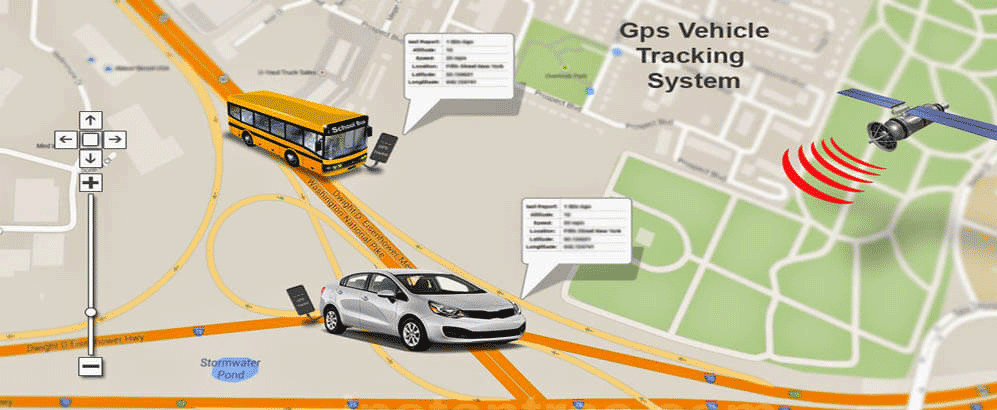
How To Build A Vehicle Tracking System : GPS Enabled

The industry which is the first to implement a vehicle tracking systems is shipping industry, because they needed to monitor their trucks position at real time or they can track every checkpoints traveled by the tracks.

Now the Question arrives that how a GPS Vehicle Tracking System Works, Lets Know about the working of the system.

GPS (Global Positioning System) uses the Global Navigation Satellite System network (GNSS) to get data about the time, location, and its vehicle speed. The Global Navigation Satellite System network includes various satellites which transmit information to GPS gizmos by using microwave signals.

GPS based vehicle tracking system easily track locations of multiple vehicles in a real time.

It consists of a GPS device installed in vehicle and a software which collects the data and information of vehicles locations on the screen. Apart from vehicle location GPS device can also send a real time data about vehicle’s condition and specific events which are set in the GPS device.

Commonly tracked events in public transport are ignition (on/off), doors (open/closed) & vehicle’s speed.

There are two ways for the GPS tracking system :
  1. Active tracking.
  2. Passive tracking.

Active tracking – It is also known as 2-Way GPS or a real-time positioning. It records vehicle positions and sends the recorded data to a centralized database using a modem. This useful for commercial purposes because it allows checking object location in the exact time.

Passive tracking – It records vehicle position in particular time points. Trilateration method allows calculating the location of  auto in time between recorded points. This type of tracking requires additional storage for recorded data, like a memory card or some internal memory.

A GPS-based Vehicle Tracking System (VTS) uses a Global System for Mobile(GSM) modem and a Global Positioning System (GPS) module for vehicle location. These system also allows performing some car controlling actions such as starting an engine and locking/unlocking doors which is very useful.

 Hardware required for building a GPS Vehicle Tracking System :

  • An LCD : (Liquid Crystal Display) is the technology used for displays in notebook and other smaller computers.
  • A GPS module : The Global Positioning System (GPS) is a network of about 30 satellites orbiting the Earth at an altitude of 20,000 km.Once it has information on how far away at least three satellites are, your GPS receiver can pinpoint your location using a process called Trilateration.
  • A GSM module : A GSM modem requires a SIM card to be operated and operates over a network range subscribed by the network operator. It can be connected to a computer through serial, USB or Bluetooth connection. GSM modem is usually preferable to a GSM mobile phone. GSM modems supports services like Telecommunication services, data services, supplementary services.
  •  A relay circuit : Relay is a switch which controls (open and close) circuits Electro Mechanically. The main operation of this device is to make or break contact with the help of a signal without any human involvement in order to switch it ON or OFF automatically . It is basically used to control a high powered circuit using a low power signal.
  • A Micro-controller unit (MCU) :Microcontroller unit has a CPU (Central Processing Unit)  in addition to RAM, ROM and I/O ports.
Best programming language:

Various languages are best suitable for programming the MCU. Some of them are Assembly language and C. Software in Assembly has fast performing time & C software is easy enough to build a tracking system. It is necessary to design a web page or create a tracking application for monitoring vehicle location by entering longitude and latitude received by the MCU (Micro-controller unit) from a GPS receiver and displayed on a LCD.

The web-based VTS consists of tracking devices placed on a car, a web application, and a central server system. Such system can be useful for shipping companies and organizations.

  • A GSM module
  • A GPS module
  • A micro controller unit (MCU)

The software development VTS consists of:

  • GSM-GPS module;
  • Web application
  • Database;
  • Desktop application.

Web design :

On this stage web application goals are:
  • Browsing account information and data tracking by clients
  • Identifying tracking data from every device
  • Storage of tracking information
  • Displaying location

Desktop application :

The software application transmits commands to the GSM/GPS device. The device sends data and information to the application server through GPRS. Then, the application define a function and transmit data protocol.

GPS tracking devices transmit a real time data to software via cellular (GSM) network. If there is  connection lost, data is stored in internal memory and transmitted when network becomes available. Modern vehicle tracking software easily allows to see and analyse data on desktop or laptop computers and Mobile devices.

Productivity & Efficiency of the System:

One of the advantages of GPS tracking systems is increased in transport related business. Ability to track commercial vehicles enables to inform customers about late delivery, changed delivery time or date in advance, predict delivery times. Tracking fuel consumption allows business to calculate exact travel costs, warn drivers about their driving style, selected routes. Many Vehicle rent company or cab services use tracking system like Ola cabs, Uber. Nowadays many  transportation companies uses tracking system.
Featured

Digital World

Key Points

  • Digital transformation is a continuous journey that changes the way businesses operate, respond to market forces and engage with customers
  • A digital culture leads with customer experience, deploys agile methodologies and leverages analytics to evaluate success  
  • Achieving digital maturity is a collaborative enterprise exercise that uses technology as an enabler

The digital revolution has launched a new era of human empowerment and engagement across business, society and in every aspect of our lives. Never before has there been a more powerful influence on human behavior, irrespective of country or culture, than the combined effect of digital technologies. The effects of this shift on society are tremendous and, in particular, are dramatically changing our leadership responsibilities whether in politics, professionals in business, teachers in school or parents raising children.

Leading in the new digital world is like walking a very thin tightrope. Digital platforms deliver immense value, enabling us to connect, collaborate and broaden our minds – raising awareness about important issues, bringing people together for a common purpose and achieving new breakthroughs. But these very same technologies can also cause people to feel isolated and disconnected, leaving them vulnerable to the malicious intent of digital perpetrators and as we have seen in recent times, even terrorist activity. The opportunity for users to fulfill the need for social interaction, entertainment and learning is almost equal to the risk of impairment to cognitive, emotional and behavioral development and even mental health issues. Digital technology is extremely powerful at either end of the spectrum, and leaders have a heightened sense of responsibility to answer the call to action.

There is no doubt that this shift in how people consume information has shaped people’s perceptions and influenced how we behave. Just look at the stark contrast between the Brexit and 2016 US presidential election results and nearly every leading poll. This gap suggests that the influence of our daily digital interactions on our perceptions and decision making is significant, perhaps even dominant; yet, we still know so little about how digital technology is truly influencing human behavior. Closing this gap – understanding the role of digital technology in shaping culture and behavior and using it to an advantage –is key to effective leadership in the future.

As the World Economic Forum asserted, “You either disrupt or are disrupted.” This statement rightfully puts pressure on leaders to change, not just with the curve, but to be ahead of the curve. CEOs, world leaders, teachers and parents alike must be initiators of change and assume responsibility for creating the digital culture and mindset and to generate a thoughtful and fruitful digital experience for those they lead (and often love). Most leaders are painfully behind and must quickly to get up to speed and:

  • Become a student of all things digital. Whether it is connecting with employees using the latest social media tool, engaging with your children, revamping outdated policies, or simply reading emerging research, leaders must be the first adopters of digital trends and get comfortable with being uncomfortable.
  • Forget hierarchy. The digital world is one of empowered, individualized experiences, and leaders must embrace that it has no boundaries or titles. By nature, digital technology is diverse and inclusive and, when nurtured, can give leaders endless opportunities to harness innovation, solve problems, share knowledge and learn from others.
  • Think beyond reality. Human workers are being replaced by a digital workforce with the unstoppable development of artificial intelligence. We’re not only talking about physical robots and self-driving cars; we’re talking about software agents that carry out repeatable routine activities with increasing cognitive ability as they “learn” by doing. Gartner predicts that by 2018, more than three million of us will have a robo-boss and 20% of articles like this will be written by a machine – take a look at Gartner’s top ten trends for 2017.
  • Hang on to your values. As we’ve seen, the spectrum of emotions, experiences and behaviors driven by digital are vast, and no one is immune to its influence. Our personal values can be easily corrupted if we are not careful in protecting them, so in the wake of all that noise, leaders – and everyone – must remember what and who is truly important, set boundaries and act accordingly.

Many will not make the journey. But those who do will find a transformative, hyper-connected world that is teeming with unimaginable opportunities. The new territory is uncharted and uncertain. But by diving in with courage, respect and care, digital technology can be the greatest gift we give to our global community

Differences between On-Page and Off-Page SEO

Your search engine optimization strategy can be divided into two different categories: on-page SEO and off-page SEO. Both are crucial to the success of an SEO campaign, but they’re on completely different sides of the fence when it comes to improving your search engine rankings. To understand the difference between the two, you have to understand, at a basic level, how search engine algorithms work. Let’s break it down.

There are two main buckets that search engines look at when evaluating your site compared to other sites on the web.

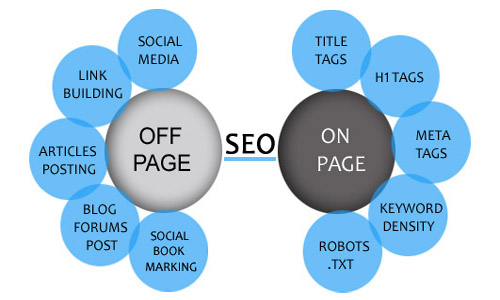
  1. On-page SEO looks at what your site (or your page) is about
  2. Off-page SEO looks at how authoritative and popular your site is

Put simply, what you rank for is largely determined by on-page factors, while how high you rank in the search results is largely determined by off-page factors.

diff-btween-onsite-offsite-seo-chart

What is On-Page SEO?

On-page SEO (also known as “on-site” SEO) is the act of optimizing different parts of your website that affect your search engine rankings. It’s stuff that you have control over and can change on your own website. Here are the biggest factors included.

Title Tags

Put your targeted keywords in the title tag of each page on your site. There are many best practices that go into writing an effective title tag.

Headings (H1)

Headings are usually the largest words on the page, and for that reason, search engines give them a little more weight than your other page copy.  It is a good idea to work your target keywords into the headings of each web page but make sure you accurately reflect your page content.

URL structure

Put keywords into your URLs if possible. However, do not go changing all of your current URLs just so they have keywords in them. You shouldn’t change old URLs unless you plan on redirecting your old ones to your new ones. Consult a professional before doing this.

Alt text for images

Any content management system should allow you to add something called “alt text” to all images on your website.  This text isn’t visible to the average visitor – alt text is in fact used by screen reader software to help blind internet users understand the content of your images. Search engines crawl images in a similar way, so inserting some relevant keywords while accurately describing the image will help search engines understand your page’s content.

Fast-loading pages, or page load speed

Google wants to help its users find what they’re looking for as quickly as possible to provide the best user experience. Therefore, optimizing your pages to load faster helps your site rank higher in the search results.

Page content

The content on your pages needs to be useful to people. If they search for something too specific to find your page, they need to be able to find what they’re looking for.  It needs to be easy to read and provide value to the end user. Google has various ways to measure if your content is useful.

Internal Linking

Linking internally to other pages on your website is useful to visitors and it is also useful to search engines. Here’s an internal link to another blog post on our site that talks more about internal linking. Very meta.

On-page SEO ensures that your site can be read by both potential customers and search engine robots. With good on-page SEO, search engines can easily index your web pages, understand what your site is about, and easily navigate the structure and content of your website, thus ranking your site accordingly.

What is Off-Page SEO?

Off-page SEO focuses on increasing the authority of your domain through the act of getting links from other websites.

A good analogy for how authority works is this. If you have a bathtub with rubber duckies in it (the ducks are your pages), and you start filling the tub with water (links), your duckies are all going to rise to the top.

This is how a site like Wikipedia ranks for pretty much everything under the sun.  It has so much water in its bathtub that if you throw another rubber duck in it, it’s going to float to the top without any other effort.

There’s a score called “Domain Authority” that calculates how authoritative your website is compared to other sites.  You can type your domain name into here to see your score.

How off-page SEO helps your site rank

The biggest off-page SEO factor is the number and quality of backlinks to your website. Some examples of ways you can build links to your website are:

  • Creating awesome content that people want to link to because it is valuable.
  • Social media shares of your content that ultimately generate links.
  • Outreach e-mails to influencers in your industry that ultimately link to you.
  • Guest blogging on sites related to yours.  These guest posts will have links back to your site.

While link quantity is still important, content creators and SEO professionals are realizing that link quality is now more important than link quantity, and as such, creating shareable content is the first step to earning valuable links and improving your off-page SEO. How many links do you need for good off-page SEO?  That is a tough question and it’s going to be based on the domain authority of your competitors, as you want to make sure you’re playing in the same sandbox. SEOs also used to believe that buying links was a valid way of link building; however, Google will now penalize you for buying links in an attempt to manipulate page rank. You can also be penalized for submitting your links to link directories whose sole purpose is to increase your domain authority. Again, quality wins out over quantity when it comes to link building.

Which One is More Important?

It’s not about choosing between on and off-page SEO, that would be like having to choose between a foundation or a roof for your house. On-page and off-page SEO work together to improve your search engine rankings in complementary fashion; however, SEOs generally advise getting your on-page SEO ducks in a row before focusing too much on off-page SEO. Just like building a house, you want to set the foundation first before building the rest of the house.  Like a foundation, you may need to come back and do some maintenance to your on-page SEO from time to time. Balancing the two will help make your website “bilingual” so that your users can understand it as well as the search engine robots- and that’s how your rankings start to improve.
Design a site like this with WordPress.com
Get started